
Say Yes to a Safer Digital Future with Sayph
If social media isn’t appropriate until at least 16, and if phones aren’t being used for any in-school learning, is there any point in a child owning a smartphone?
Will a brick phone suffice, or do we want to offer our children a half-way point? Thankfully, the UK market has expanded its options, one of which is the Sayph.
“Everything a child needs. Nothing they don’t.” So say the founders.
As a teacher, I would quibble with the verb choice: does a child ‘need’ maps or ‘need’ a camera? No, but they are useful.
As a Regional Lead for Smartphone Free Childhood, I regularly talk to parents about what they think their children need, and they tend to fall into one of three camps. At one end is the brick phone-only camp. They want to delay giving their child a phone until they start secondary and, at least for the first years, they simply want their child to be able to make phone calls and receive texts.
At the other end are those that want to offer their (often older) children limited access to the features of a smartphone with the provision of carefully selected apps, such as Duo Lingo and Spotify, either through a locked down smartphone or a follow-on phone that doesn’t have access to social media or a web browser but does have a library of vetted apps.
The middle camp wants their children to have access to a few features that a brick phone can’t offer, such as a camera, maps, and music, but without the library of apps to vet (and for your child to potentially nag you into getting). They also want to be able to monitor and approve who is contacting their child.
The Sayph falls into this middle camp.
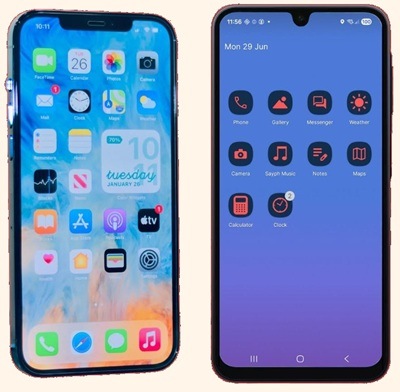
In addition to the Sayph phone (a Samsung A16 at £189) you pay a monthly subscription of £4.99 for Sayph Space, the parent portal. It allows you to track the location of your child (but you can choose to turn it off). It provides you with a ‘communication health check’, a daily score of how safe the messages your child is receiving are.
It is AI-generated so I would recommend clicking the “Activity Monitoring” tab to read the messages. When trialling the Sayph, my mother sent me a message about Lupine Racing, a company that provides a similar experience to Race Across The World but Sayph’s AI thought the message was explicit; how ‘lupine’ (normally referring to a genus of plants in the legume family) could be seen as explicit is beyond me!
The Sayph Space is also where you approve contacts and where you set routines – times within the day in which the phone goes quiet, except for two lock screen buttons to phone parents.
The founders have thought hard about balancing safety with features a child might benefit from. There is a camera but the parent chooses whether selfie mode is available and there is no option to post online or sync to a cloud.
The phone comes with maps but, unlike mainstream map apps, there are no reviews, user-posted photos or ways onto the open web.
Your children will have access to music – if you want them to; they can access a curated list of radio stations as well as an integrated MP3 player, allowing them to enjoy their own music. Unlike many mainstream platforms such as Spotify, Sayph Music does not include video content, online communities, or recommendation algorithms, helping parents avoid these distractions.
Add to this a weather app, a notes app, a calculator, one-to-one text only messaging and the thing that started it all – the phone – and there you have it.
The Sayph phone deliberately doesn’t have WhatsApp. According to Ofcom, 56% of online bullying of children happens on messaging apps. Any member of a chat can drop in violent clips, porn, or racist or misogynistic material which, because of “view once” messages, can be gone before a parent has the chance to see it.
Furthermore, WhatsApp Channels let children follow influencers and the content they are pushing, often leading the messaging service to be called the ‘gateway drug’ to other social media.
Many parents have told me that they found the cheapest option was to lock down an old smartphone but then found out it needs thorough research, constant monitoring and the lock down falls apart as soon as a curious child sees your pin.
You may have seen in the news that an iPhone built after 2018 has an Assistive Access feature, that can strip it back to calls, messages and selected apps with no browser or app store, but a locked iPhone is still an iPhone and your child knows it.
It’s a subtle distinction to the Sayph but it’s worth considering. With a locked down iPhone, your child knows that you and a four-digit passcode are the only things standing between them and TikTok, whereas a dedicated children’s phone cannot install apps; the restriction belongs to the phone, not you.
So, does the Sayph offer a useful middle ground? I think it does. It gives children some of the useful features of a smartphone without giving them access to the open web, social media or an app store, while giving parents a degree of oversight and control.
There are still things to consider – including the cost, the monthly subscription and the limitations of AI-generated safety monitoring – but if you are looking for something between a brick phone and a mainstream smartphone, the Sayph is certainly worth considering.
Just as the government announcements take the onus away from parents being the only boundary setter, the Sayph creates a barrier against social media access, making the life of a parent that little bit easier.
Now, doesn’t that sound nice?