
The Parent We Trust
In my spare time, I rear calves – caring for baby cows that have been separated from their mothers. It’s a role some people question. But the calves in my care are healthy, well fed, content and thriving, despite the fact I’m not their mum.
And it got me thinking about parenting – and who we instinctively trust to do it.
That brings me to a friend of mine, who separated after years of their partner struggling with alcohol and prescription drug misuse. It wasn’t hidden. There were incidents that put their three children at risk: driving under the influence, falling asleep while responsible for them, behaviour serious enough that contact eventually had to be supervised.
But within months, things changed. The parent in question convinced professionals they were well again, and shared care resumed. Not through the courts, but because my friend believed – as many of us do – that children need both parents in their lives wherever possible.
Pause for a moment: who did you picture as the struggling parent in that story – father or mother?

Many of us would like to think we don’t make assumptions. But often, without realising it, we do. Instinctively, many still expect “the dad to be the problem”. In this case, it was the mother.
My friend, let’s call him D, now spends half his life worrying. His fears are not abstract. They are rooted in lived experience, in patterns of behaviour he has seen before. Another father I spoke to described something similar: he believes his ex-partner is still using drugs while caring for their children, but feels powerless to intervene.
Legally, the picture is more balanced than many people assume. Under the Children Act 1989, courts are required to prioritise the welfare of the child above all else, rather than favouring one parent because of gender. Fathers who actively pursue custody or shared care are frequently successful in securing meaningful involvement in their children’s lives. Most arrangements are never decided by a judge at all. They’re agreed informally, shaped as much by social expectations as by law. Around 90% of UK child arrangement cases are resolved without a full court hearing.
Yet statistics only tell part of the story.
In practice, mothers still tend to become the primary carers after separation, largely because they are more often the main caregivers beforehand. And while that may reflect long-standing social patterns rather than explicit legal bias, those patterns shape expectations in powerful ways.
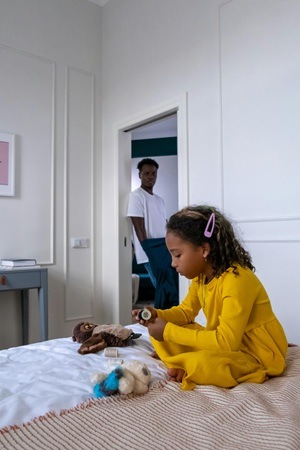 Mothers are still widely seen as the default parent – more essential, more nurturing, more trustworthy. Fathers, meanwhile, are often viewed as secondary caregivers, or as risks to be managed. At the same time, mothers can also be judged more harshly when they fail to live up to those ideals.
That perception matters.
In D’s case, concerns raised with the school and authorities have led nowhere. His ex-partner now works at the children’s school. Allegations of ongoing addiction are brushed aside, while stories about him circulate freely. When something goes wrong, he feels the suspicion falls naturally towards the father.
“No matter what happens,” he told me, “she comes out smelling of roses.”
I’m a mother myself. When I left a toxic relationship, I was believed without question. Nobody challenged my account or asked whether I might be exaggerating. Would the response have been different if I were a man? I can’t honestly say otherwise.
None of this is to suggest that the legal system is stacked against fathers. The evidence is more nuanced than that. Serious safeguarding findings – what people casually call a parent being “unfit” – are relatively uncommon and can apply equally to either parent when risks such as addiction, abuse or neglect are substantiated.
But outside the courtroom, life is messier than legislation.
Because while the law may strive for neutrality, people often do not.
Teachers, neighbours, friends, even professionals carry assumptions about what mothers and fathers are supposed to be. And when safeguarding concerns depend partly on who is willing to listen, those assumptions can shape outcomes in ways we rarely acknowledge.
We have spent decades – rightly – pushing towards equality between men and women. But genuine equality also requires us to confront an uncomfortable truth: mothers are not automatically safer, kinder or more suitable parents simply because they are mothers.
As with calf rearing, parenting is not ultimately about who gave birth. It is about who shows up, who keeps children safe, and who enables them to thrive.